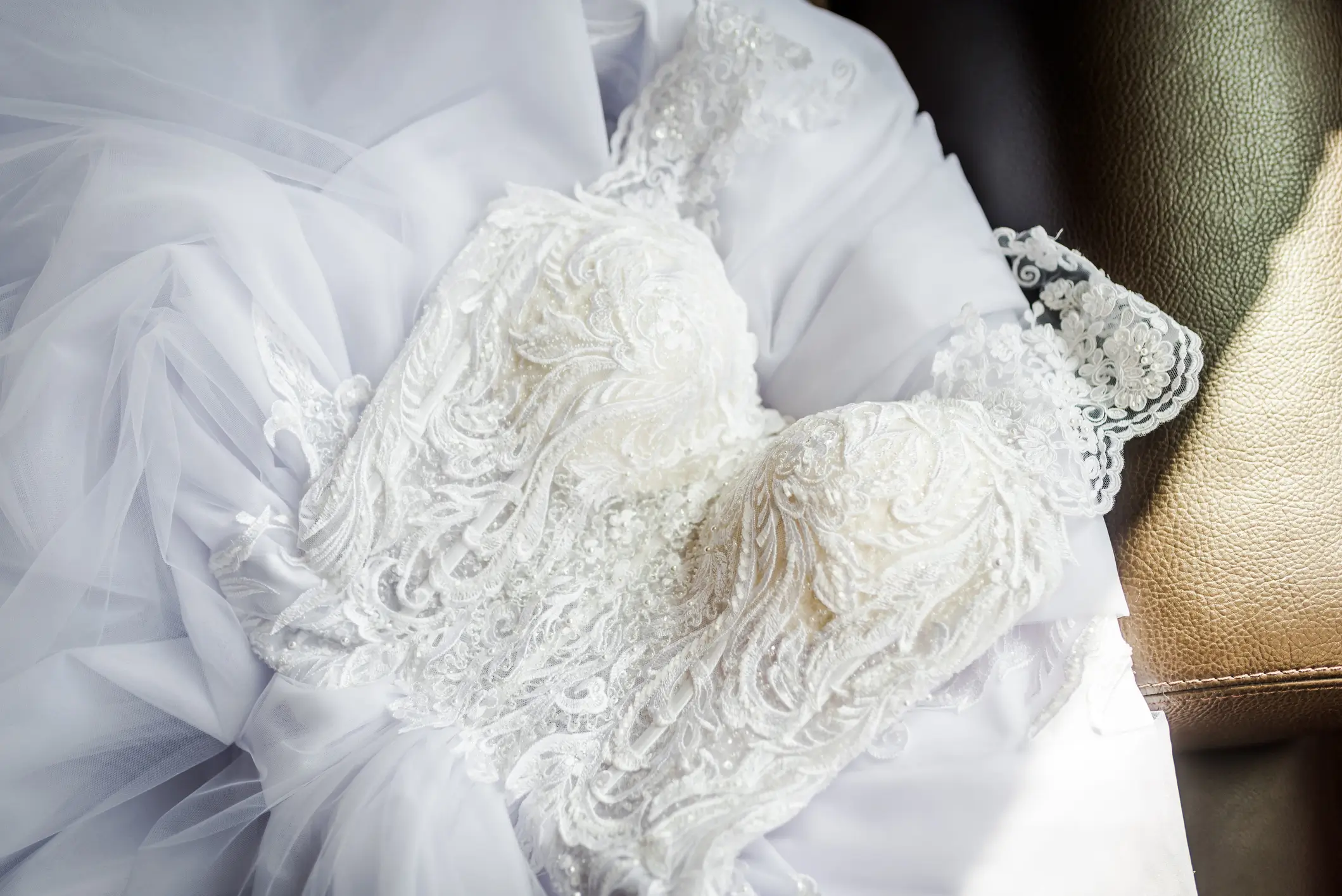
Your wedding dress came back from the cleaner spotless. The champagne stain is gone, the hem looks fresh, and you hung it up feeling like the job was complete. What nobody tells you at the counter is that cleaning and preservation are not the same service.
Cleaning removes what's on the dress today. Preservation controls what happens to it over the next thirty years. Doing the first doesn't do the second, and that gap is why dresses that were cleaned perfectly still end up yellowed, stretched, or damaged years later.
Cleaning handles what's on the dress right now: the champagne, the makeup, the grass stains on the hem. It's a one-time job that ends when you pick up the dress. Preservation is different. It protects the fabric from air, light, humidity, and whatever it's stored against for years to come. A dress can be perfectly clean and still yellow within five years if the storage conditions are wrong.
Most brides never hear this distinction, because the cleaning transaction ends at pickup. Nobody brings up year three unless you ask.
The word preservation gets used loosely. Some cleaners mean a nicer garment bag. Others mean a full archival process with acid-free materials and a sealed or unsealed box. If your dress was preserved as part of a standard cleaning package, ask exactly what that included. The terms blur often enough that plenty of brides assume they've already covered this step when they haven't.
This is the part you can act on today. The plastic bag your dress came home in is transport packaging. It was designed to get the garment from the shop to your car, not to store it for the next decade. Sealed plastic traps residual moisture against the fabric, and some plastic films off-gas compounds over time that actively contribute to yellowing.
Here's the practical consequence: a cleaned dress left sealed in a bag for two years can end up in worse condition than an uncleaned dress stored loosely in cotton. The cleaning didn't cause the problem. The storage did.
You don't need a full preservation service to make this better right now.
A few immediate steps:
None of this costs money, and none of it requires a decision about full preservation. It just stops active damage while you figure out your next step.
Why does your wedding dress look yellow if it was cleaned? If your dress was cleaned and is turning yellow months or years later, it's usually one of three things, and it's rarely a sign the cleaning was done poorly.
None of these is a cleaning failure. They're the reason cleaning alone doesn't stop the clock.
This explains why yellowing often shows up in patches instead of evenly. Clear liquids, such as champagne, prosecco, white wine, and tonic water, leave no visible mark when they dry, so they're rarely pointed out or spot-treated. The sugar stays in the fibers and slowly oxidizes into a brown patch months or years later, on a dress that looked flawless the day it came home.
If you remember something clearly spilling during the wedding, even without a visible mark now, mention it to whoever handles your dress next.
This is a different kind of damage entirely, and it's mechanical rather than chemical. A wedding dress is heavy, especially with beading, a structured bodice, or a long train, and all of that weight pulls on whatever holds it up. Over years on a hanger, that constant load stretches shoulder seams, elongates straps, and permanently distorts the shape of the bodice.
Thin wire or plastic hangers make this worse because they concentrate the entire weight of the dress into two narrow points instead of distributing it.
This is different from yellowing, and so is the fix. Yellowing is chemical and can sometimes be treated or lightened. Stretching from years of hanging weight is structural. Cleaning and pressing address surface appearance, but neither reshapes fabric that's been permanently stretched out of position. Once a seam or strap stretches under sustained weight, that change tends to stay part of the garment.
This is what you actually pay for when a preservation process is done properly, and it's worth knowing the components so you can tell a real process from a vague promise.
Preservation is environmental control and structural support. Cleaning was never designed to do either of those things, which is exactly why the two need to be treated as separate decisions.
Ask what materials are used and how the dress is stored long-term. A real process uses acid-free tissue throughout and seals the dress in a proper preservation chest, protecting it from light, humidity, and yellowing for the long haul. If a shop can't describe that level of detail, or if preservation turns out to mean a nicer garment bag, it's not the same service.
Usually, no. Early oxidation and general yellowing across the fabric frequently respond well to professional treatment, and some structural distortion can be improved with the right support and time. But the odds decline the longer a dress sits in poor conditions, and certain kinds of damage, such as mildew staining or fiber breakdown from prolonged humidity exposure, can be permanent.
More than anything else, the outcome comes down to two variables: how long the dress has been stored, and the conditions in which it was stored. A dress that spent three years in a climate-controlled closet in a breathable cover is in a very different position than one that spent three years in a garage or attic sealed in plastic. If you're unsure which category your dress falls into, that's the exact purpose of a condition assessment, and it costs you nothing to find out.
If your dress has been cleaned but never preserved, here's the order of operations:
If your dress has been cleaned but never preserved, you're not behind; you just haven't had the full picture until now. That's exactly why we treat dress preservation as its own service, not an add-on.
At Blue Ribbon Cleaners, wedding dress preservation is something we handle ourselves, not something we outsource or rush. Every dress that comes through our doors goes through a detailed inspection first, then hand cleaning, expert finishing, and long-term sealing in a museum-quality preservation chest with acid-free tissue throughout. That's how we make sure nothing gets missed between drop-off and dress preservation.
Interested in preserving a wedding dress? Stop by or give us a call. We'll walk you through the process and what it involves for your specific dress.
Locations:
4431 Logan Way, Youngstown, OH
8063 E. Market St., Warren, OH
3433 Belmont Ave., Youngstown, OH
Phone: +1 330 632 1873